FilmThe OdysseyChristopher Nolan · 2026
The Odyssey — The Moral Defeat of Victory
We see what you’re trying to do, Nolan, but how far can you take it…
A great deal has already been written about The Odyssey, but what made me appreciate the film in particular was the connection I drew between it and another film: Terrence Malick’s The Thin Red Line. In both films, a military victory is ultimately presented as a moral defeat.
In The Thin Red Line, Malick poisons any sense of triumph the audience might experience by showing American soldiers resorting to murder, humiliation, and looting after capturing the Japanese positions. A military objective has been achieved, but that achievement becomes a moment in which humanity itself is lost. Malick does not turn this into a magnificent spectacle of war in the manner of Apocalypse Now. Instead, he continually introduces a sense of unease into the images, leaving the viewer with the feeling that something is deeply wrong.
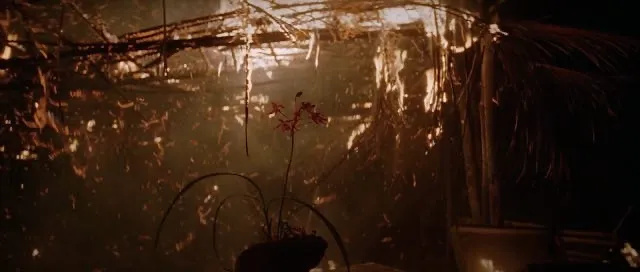
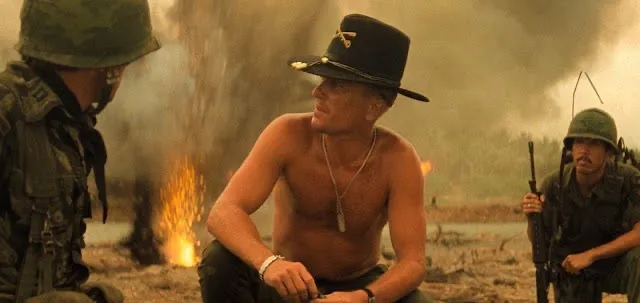
At this point, Jean Baudrillard’s critique of Apocalypse Now also comes to mind. According to Baudrillard, rather than looking at the Vietnam War from the outside and establishing a critical distance from it, Coppola makes his film with an excess resembling the way the Americans conducted the war itself: the same technological power, the same lack of restraint, and the same logic of special effects. The film therefore does not merely depict the war; in a sense, it reproduces the system of spectacle and technology that made the war possible. Malick, by contrast, constantly attempts to resist the seductive power of images of warfare.
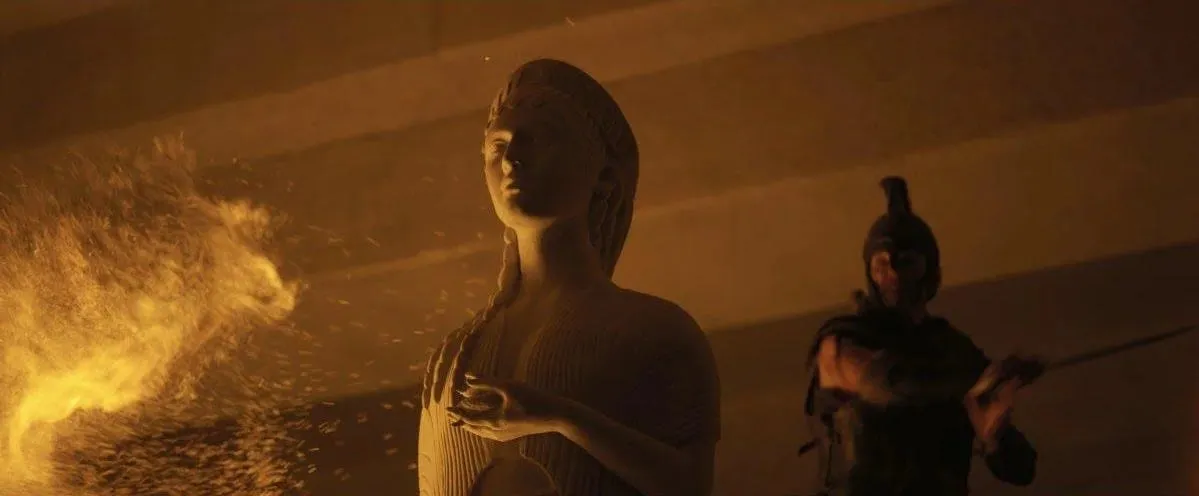
Nolan similarly refuses the pleasure that might arise from viewing the Trojan Horse as an ingeniously planned act of heroism. He makes us witness the consequences of the plan through the indiscriminate killing of soldiers and civilians, the plundering of temples, and the burning of the city. The horse, a product of Odysseus’s intelligence, thus ceases to be a symbol of victory and becomes an instrument of mass violence.
The amount of time devoted to the fall of Troy is also significant. Although Homer’s Odyssey refers to the Trojan Horse, it does not narrate the destruction of the city from beginning to end. Nolan draws particularly on Book II of Virgil’s Aeneid—in details such as Sinon and the Trojans’ decision to bring the horse inside the city—to expand the moral background of the narrative. He shifts the perspective away from the epic of those who won the war and toward the devastation experienced by those who lost it.
The film achieves this most effectively through Agamemnon. In Troy, we usually perceive him without seeing his face: enclosed in black armour, unstoppable, and almost superhuman. We then see this seemingly indestructible figure murdered in his own home, naked and defenceless in his bath. The film first presents the myth of Agamemnon as it exists in the minds of the soldiers and Odysseus, and then reveals that beneath this myth lies an ordinary, vulnerable, mortal body.
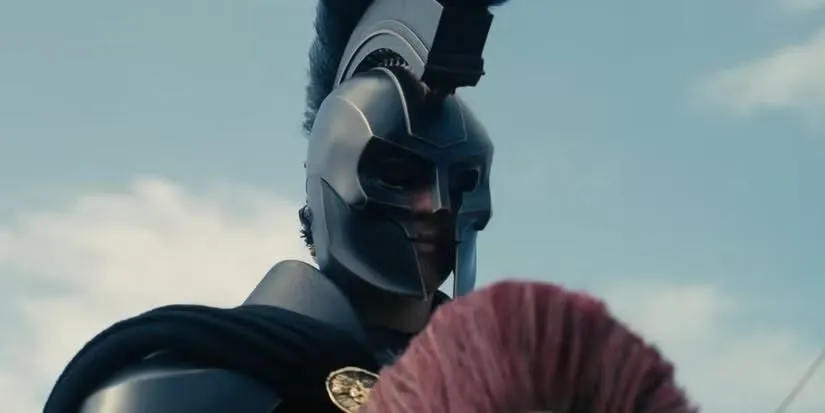
Here, Nolan also combines several different ancient traditions. Agamemnon’s betrayal and murder after returning home appear in Homer’s Odyssey. His murder in the bath by Clytemnestra, however, and the emphasis on the killing as revenge for the sacrifice of Iphigenia, derive more directly from the tradition of Aeschylus’s Oresteia. The film brings these two versions together within the same work.
The idea here, in my view, is not simply that following leaders is meaningless. It is something harsher: devotion to a leader does not absolve a person of their own moral responsibility. By imagining Agamemnon as an invincible figure, the soldiers surrender both their agency and their guilt to him. Yet when Agamemnon dies, their actions do not disappear. The leader is mortal; the consequences of the violence carried out under his command are not.
Agamemnon’s death also demonstrates that the violence of war does not remain in enemy territory. The violence that began when he sacrificed his daughter for the sake of the war returns home with him after the destruction of Troy. Agamemnon has won the war, but he cannot escape the violence of the order he created. Victory cannot protect him from the death waiting in his own home.
At the same time, the film becomes more than a story about Odysseus’s return. The former life to which Odysseus longs to return is no longer the same; more importantly, the former Odysseus who might have returned to that life no longer exists. As the creator of the Trojan Horse, he comes to believe that he did not merely win a war. He also transformed the traditions of hospitality and gift-giving—the very customs that make trust between human beings possible—into weapons.
The horse was presented to the Trojans as a gift, yet it carried death inside it. Nolan thus places xenia, one of the fundamental values of the ancient Greek world—the sacred bond of trust between guest and host—at the centre of the film. Odysseus’s invention has not only destroyed Troy; it has also poisoned people’s trust in gifts, in guests, and in one another.
Odysseus’s journey therefore becomes not only an attempt to reach home, but also a state of continually postponing his arrival. His repressed guilt gradually transforms the journey itself into a system of self-punishment. He does not forget what he has experienced solely because of Calypso’s influence; he is also afraid to face his family as someone who must bear responsibility for what he has done. The question is no longer simply, “How can I return home?” It becomes, “After what I have done, do I still have the right to return?”
Zendaya’s dual casting creates the most powerful rupture in the film’s interpretation of Athena. Because we see her as Athena throughout the film, we assume that Odysseus remains under divine protection. But when we discover that Zendaya also plays a young Trojan woman killed during the sack of Troy, Athena’s function is reversed.
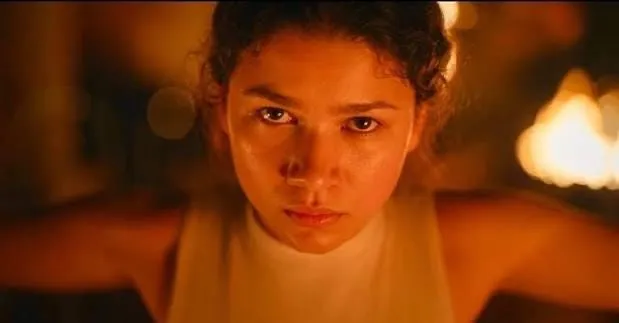
In Homer, Athena largely supports Odysseus’s intelligence and capacity for deception. She admires his cunning and helps him return home. In Nolan’s film, however, the same image of Athena reminds Odysseus of the deaths caused by that intelligence. In Homer’s world, Odysseus’s deceptions are legitimised by divine assistance; in Nolan’s world, those same deceptions return to confront him as a form of guilt he cannot repress.
In Homer, Agamemnon’s murder as a result of the betrayal of Aegisthus and Clytemnestra serves as a recurring counterexample to Odysseus’s return. Agamemnon comes home openly and confidently after the war. Odysseus, by contrast, arrives in Ithaca in disguise, observes the situation within his household, and tests whom he can trust. The returns of Agamemnon and Odysseus are compared, as are the actions of Clytemnestra and Penelope, and those of Orestes and Telemachus.
In Nolan’s adaptation, this ancient warning is expanded to include the idea that a person returning home from war may become alienated not only from those around him, but also from his own past. The nostos at the centre of the epic therefore ceases to be a destination waiting to be reached. Instead, it becomes a fragile confrontation shaped by trauma, shame, and moral responsibility.
- A quintessential Nolan adaptation
- IMAX experience
- Soundtrack
- Anachronisms
- Action sequences
- Overly star-studded cast